Showing posts with label advanced practice nurse certification. Show all posts

Tuesday, 26 May 2020

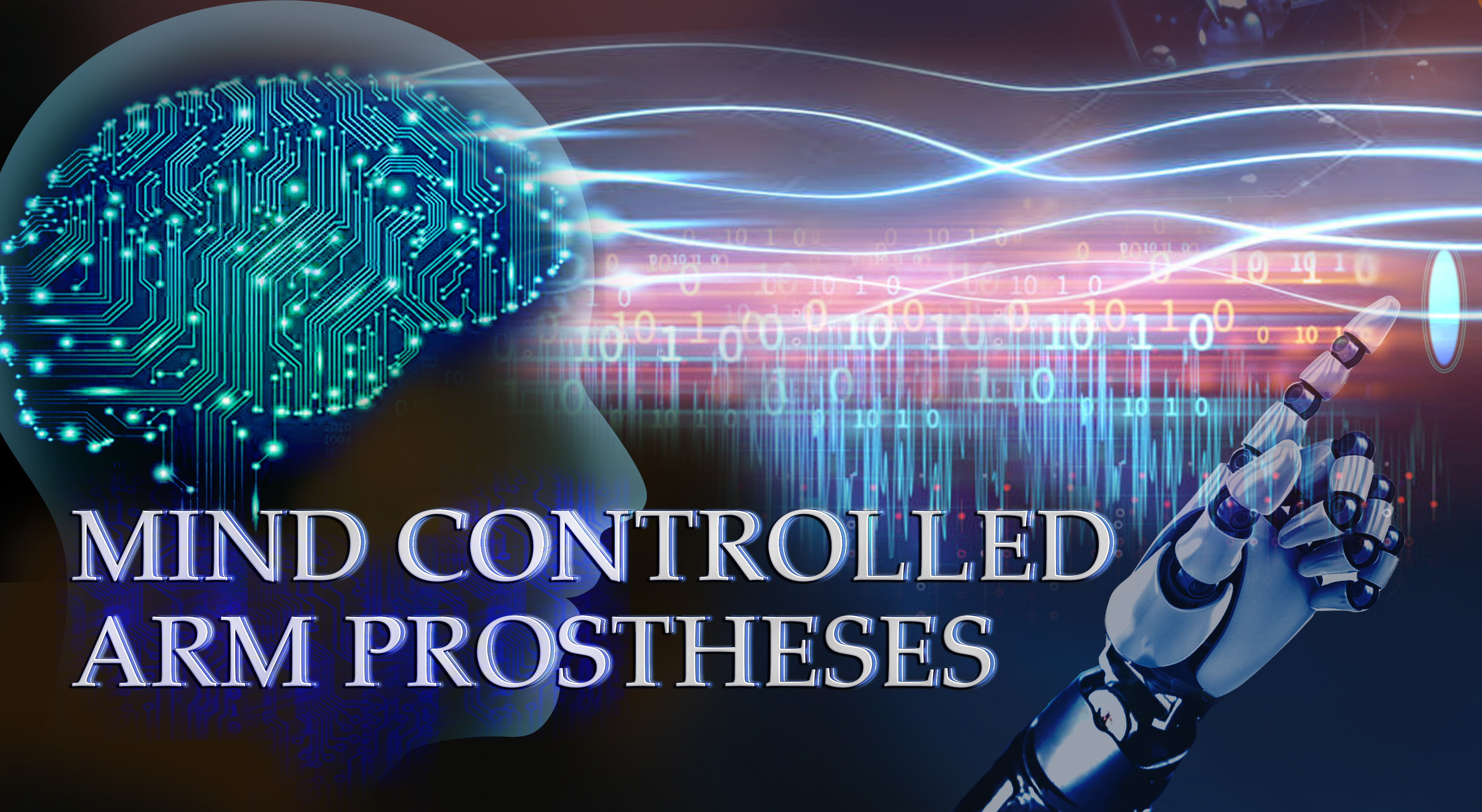
Mind Controlled Arm Prostheses


mind-controlled arm prosthesis
For the First time, people with limb amputations can experience sensations of touch with a mind-controlled arm prosthesis. A study in the New England Journal of Medicine reports on three Swedish patients who have lived, for several years, with this new technology. This is one of the world’s most integrated interfaces between human and machine.
The research was led by Max Ortiz Catalan, Associate Professor at Chalmers University of Technology, in collaboration with Sahlgrenska University Hospital, University of Gothenburg, and Integrum AB, all in Gothenburg,
Sweden. Researchers at Medical University of Vienna in Austria and theMassachusetts Institute of Technology in the
USA were also involved.

“Our study shows that a prosthetic hand, attached to the bone and controlled by electrodes implanted in nerves and muscles, can operate much more precisely than conventional prosthetic hands. We further improved the use of the prosthesis by integrating tactile sensory feedback. This is used by the patients to mediate how hard to grab or squeeze an object. Over time, the ability of the patients to discern smaller changes in the intensity of  ensations has improved,” says Max Ortiz Catalan.   The patients have used a mind-controlled prosthesis in their everyday life for up to seven years. For the last few years, they Max Ortiz Catalan, Associate Professor at Chalmers University of Technology have also lived with a new function. The sensations of touch in the prosthetic hand. This is a new concept for artificial limbs, which are called neuromusculoskeletal prostheses. They are connected to the user’s nerves, muscles, and skeleton. “The most important contribution of this study was to demonstrate that this new type of prosthesis is a clinically viable replacement for a lost arm. No matter how sophisticated a neural interface becomes, it can only deliver sensations of touchreal benefit to patients if the connection between the patient and the prosthesis is safe and reliable in the long term. Our results are the product of many years of work, and now we can Finally present the first bionic arm prosthesis that can be reliably controlled using implanted electrodes, while also conveying sensations to the user in everyday life,” continues Prof. Catalan. Since receiving prostheses, the patients have used them daily in all their professional and personal activities.
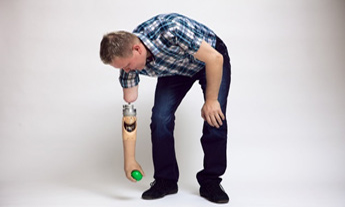
The newest part of the technology, the sensation of touch, is possible through stimulation of the nerves that used to be connected to the biological hand before the amputation. Force sensors located in the thumb of the prosthesis measure contact and pressure applied to an object while grasping. This information is transmitted to the patients’ nerves leading to their brains. Patients can thus feel when they are touching an object, its characteristics, and how hard they are pressing it, which is crucial for imitating a biological hand.
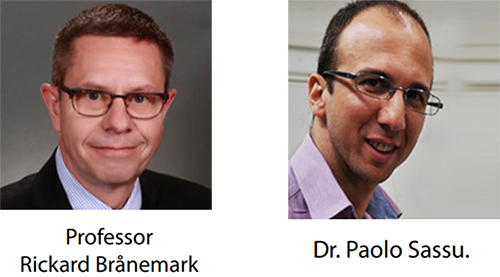
The implantation of this new technology took place at Sahlgrenska University Hospital, led by Professor Rickard Brånemark and Dr. Paolo Sassu. Over a million people worldwide suffer from limb loss, and the end goal for the research team, in collaboration with Integrum AB, is to develop a widely available product suitable for as many of these people as possible.
The current study dealt with patients who had above-elbow amputations, and this technology is closer to becoming a finished product. The research team is working in parallel with a new system for amputations below the elbow. In those cases, instead of one large bone (humerus), there are two smaller bones (radius and ulna) to which the implant needs to be anchored. The group is also working on adapting the system for leg prostheses. In addition to  aplications within arosthetics, the permanent interface between human and machine provides entirely new opportunities for scientific research into how the human muscular and nervous systems work.

REFERENCES
1. Chalmers University of Technology. (2020, April 30). Mind-controlled arm prostheses that ‘feel’ are now a part of everyday life. ScienceDaily. Retrieved May 12, 2020 from  
2. Fan, S. (2019, July 31).”Moving Beyond Mind-controlled Limbs to Prosthetics That Can Actually ‘Feel’.”Retrieved May 12, 2020 from 

3. ”Mind-Controlled Prosthetic Arm Moves Individual ‘Fingers’.” (2016, February 15).Retrieved May 12, 2020 from
https://www.hopkinsmedicine.org/news/media/releases/mind_controlled_prosthetic_arm_moves_individual_fingers_

4. ”Neuroscience researchers receive $3.4 million NIH grant to develop brain-controlled prosthetic limbs.”(2018, October 5). Retrieved May 12, 2020 from 

Monday, 2 March 2020

Nurse Practitioner Education: Becoming an Advanced Practice Nurse

If you're looking into a nursing occupation, you already know that you want to care for people, but how do you decide if nurse practitioner education is right for you? The first thing to do is look at all the possibilities for training, economics, and occupational outlook.

Becoming a nurse practitioner is a step up in education and responsibility from an LPN or an RN. While the wide variety of occupational areas is still there, you are now boosting your profession to the level of the diagnostician. These professionals work in hospitals, health clinics, and doctor's offices, but diagnose their own patients, write prescriptions, and order patient care.
Depending on whether you are in a hospital, clinic, or specialty area of medical practice, as a nurse practitioner you might be called upon to regularly perform many of the following duties:
• Ordering routine tests and taking case history information for diagnosis
• Performing routine incisions and sutures, drainage and wound care, and tissue biopsies
• Executing nasal intubations into the stomach, and gastric analysis
• Testing for insulin and glucose tolerance
• Ordering lab studies and prescribing routine medications
There is a rigorous standard for training to accompany this higher level of responsibility, but if caring for people is your gift, it's worth it to get the extra one- or two-year master's degree training required to be able to serve your chosen community more comprehensively.

So, what's involved in nurse practitioner education that differs from LPN or RN training? Most programs require prospective students to have registered nurse licensure and to have practiced as an RN for about two years.

Master's level programs add several hours of advanced pharmacology to the RN base of knowledge, along with intensive practice each semester in different areas. There is a practicum in paediatric care, adult care, child health, and care of at-risk populations. All courses are progressively more complex than those offered in registered nurse training.

Some good news for prospective students is that some or all a master nurse practitioner education may be attained online while continuing to work as an RN. There is abundance of approved quality online MSN programs, which can be worked at part time or full time.

Upon completion of the master's degree in nursing, national certification by exam is required. There are several national nursing organizations approved to certify nurse practitioners. Two such organizations are the American Nurses' Association and the American Academy of Nurse Practitioners.

Some associations are specialty certifying organizations for family nurse practitioner certification exam, AGNP, AGACNP, and PMHNP certification Review (online psychiatric nurse practitioner programs). Certification exams are administered throughout the country and cost around $24.99 per Month to $300/ 3 year.

According to the Department of Labour, the median hourly wage of an RN is about $31, and when you become a nurse practitioner it can jump to $45. Of course, the bump up to master's level in any profession offers a higher earning potential.

One of the most compelling things about pursuing nurse practitioner education, aside from the value of working with patients directly, is the economic advantage it offers. By acquiring advanced education, registered nurses can re-invent themselves and open new and exciting pathways.

Thursday, 2 August 2018

How Long Does It Take To Become A Nurse? APRN World


Careers in health care are booming right now, and nursing is one of the careers that is both lucrative and flexible in terms of hours, location, duties and opportunities. Along with wondering how to become a nurse, many people wonder how long it will take to become a nurse as well. The answer is that it depends on what kind of nurse one would like to be and how one goes about obtaining a nursing degree. There are a number of different avenues to becoming a nurse.
The first level is LVN or LPN also known as Licensed Vocational Nurse or Licensed Practical Nurse. This requires the least amount of education and thus the least amount of time for becoming a nurse. Nursing programs of just one year prepare an individual to become and LVN or LPN. After finishing their coursework, LVNs and LPNs must pass an exam in order to be licensed and certified by the state. Career options are not as plentiful or flexible at this level, but it can be a good introduction to the field, and individuals who start out as LPNs or LVNs can return to school for further education if they want to advance.

Becoming a RN is the next level. RNs have three paths to becoming a nurse that take different amounts of time. An associate’s degree or a diploma program in a nursing school both take two years. Nursing school diplomas used to be the usual way of moving into a career as an RN. However, the increasingly common path for people seeking to work as RNs is the four-year bachelor’s degree. A two-year program is generally limited to a narrower technical scope while a four-year program has greater professional scope. An associate’s degree will prepare a nurse to work effectively in most settings. With a bachelor’s of science in nursing, however, a nurse will have the opportunity to study nursing theory as well as develop a method of practicing with a background in psychology and other fields that overlap with nursing practice. A bachelor’s degree also prepares the RN for further advancement and study if so desired and gives the nurse
a better-rounded education in the field. After obtaining a degree, an RN also must pass a state licensing exam.
The advanced practical registered nurse or APRN encompasses several different types of nurses including nurse practitioners, best family nurse practitioners, top acute care nurse practitioner and clinical nurse specialists. This is generally training obtained at the master’s level. This adds two additional years to the course of study for a total of six years, but work as an APRN is often preceded by several years of work experience. Nurses at this level tend to specialize in a single area such as ccrn or agnp. Depending on the state and type of practice, some types of APRNs may work quite independently. In some states, for example, a nurse practitioner can write prescriptions and a certified nurse midwife can run a private practice without being paired with an obstetrician. A master’s degree also prepares nurses to move into administration.

There are also advanced degree courses in nursing at the doctoral level. This prepares nurses for teaching and research among other things. A doctorate can take three or four years or considerably longer. The doctor of philosophy programs that award a PhD focus on research while a DNP or doctor of nursing practice has a more clinical focus.

Becoming a nurse, therefore, can take anywhere from one to four years for a licensed vocational or practical nurse or a RN, but nurses who want to continue their education, work in a specialized field or even set up their own practices as nurse midwives can do in many states will want to spend more time on their education. At advanced levels, higher education is most successfully paired with experience, so it could take nurses a number of years to establish
themselves as experts in a particular field. However, nursing salaries at the RN level nearly everywhere and at the LPN/LVN level in some states are good enough and schedules are flexible enough that it is sometimes possible for nurses to attend further classes part-time while working reduced hours.

APRNWorld is valuable resource for healthcare providers in updating clinical and practice knowledge through Continuing Education (CE). At APRN World we share interesting educational stuff that can help people choose the best nursing courses and certification. If you are seeking for nursing programs to become a nurse in United States follow APRN world. APRN World ranked the Best APRN Certification Exam & ARNP Programs. Compare schools by price and convenience. Earn your Nurse Practitioner certification online.

Wednesday, 28 March 2018

Moving On To Online Best Nurse Practitioner Programs


If you are currently working within the health field as a practical nurse or registered nurse, then you definitely understand first-hand how short-staff of your working profession is and the way advancing in your career through taking on-line best nurse practitioner programs could be meaningful. The development to nurse practitioner is a growing demand in the health profession internationally.

In order to advance to a top acute care nurse practitioner you will be required to complete either a master's degree or a Doctoral degree. With great training and practice through additional training you'll be ready to simply accept the responsibilities that include the nursing practice over those of a traditional registered nurse. Irrespective of which online best nurse practitioner education you choose, persevering with your education could take years to achieve, relying on the level that you begin at.